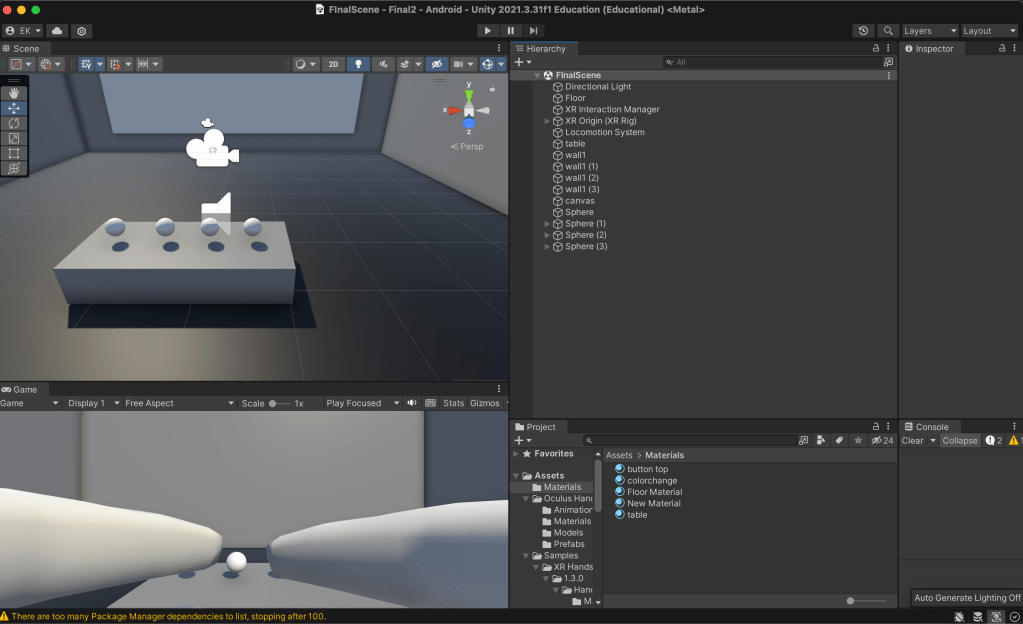
For our final project for the class Intro to VR, ATLS 4616, we were able to test different forms of the same interaction to see what tested best with our classmates. I was originally going to test different interactions related to shooting/fighting weapons, but I have been having trouble with my Unity and saving files to my computer recently, as well as actually connecting Unity to my oculus. I decided to instead test different interactions for when you were going to pick up a block. This would be a hover effect for the most part, and would help for haptic feedback in a game to show that a user can interact with an object.
source code: Link to my Unity file on a google drive link, would need to open a new file and upload everything as assets to use. I had to configure a lot of project settings as well as install a couple packages, to which I used this tutorial to set it up.
Interaction 1
The first interaction I tested was when the interactable(sphere/block/thing to grab) itself would change color when hovered on or picked up. I chose a blue color for when it was being hovered over, and a red color for when it was picked up
When testing this in class, this seemed to be a favorite of everyones. I believe this is because it has the most obvious visible outcome, which lends well to good feedback.
Interaction 2
The second interaction that I tested was where the laser coming out of the hand would change its color when hovering over the interactable.
This interaction seemed to be the least favorite out of everyone, probably because the feedback was least noticeable as compared to the other interactions.
Interaction 3
The third interaction that I tested was where the interactable would make a sound when hovered over.
People seemed to find this one amusing at first, but eventually agreed that it wasn’t one of the best options. Audio feedback would be ranked under visual feedback for people.
Interaction 4
The fourth interaction that I tested was where the interactable would grow when hovered over.
This was the second favorite interaction, I think this was because it also a visual feedback that was easy to see.
Questions and Answers
Before people interacted with my project, I asked them 3 starting questions for them to think about while interacting, then asked them 3 follow up questions after they finished.
Pre-test questions
- Have you used an Oculus or other type of VR system before to play games?
- Do you know what haptic feedback is? What is your favorite type of haptic feedback?
- Can you think of a type of haptic feedback you use in everyday life?
Pre-test answers
Most people responded yes to the first question, which I suppose makes sense as we are in a class about VR and it would attract people who have experience with it. For the couple people who said no I made sure to explain the general controls of the Oculus, and to everyone I explained the specific controls my game used. Most people also responded yes to the second question, though did not know a specific definition but more knew the term through everyday interactions, which is why I asked my last question. People said interactions like flipping on a light switch and having light turn on, scanning or swiping their buff card and a light/sound happening, or having their phone buzz them when on google maps and the next turn was coming up. Most descried haptic feedback in physical life, but a couple people talked about types of feedback they have while playing video games, like the buzzing of their phone when catching a pokemon on pokemon go.
Post-test questions
- What was the most engaging interaction?
- What 2 interactions would you combine into one type of feedback?
- What is another type of feedback you could think of the implement after seeing these ones?
Post-test questions
It was a pretty even split between people liking the color changing interaction, and the size changing interaction. I talked a little bit about it above, but I feel that people liked these interactions the best because they had the most obvious visual feedback. It was the interaction easiest to spot, and one that is probably more popular in games and apps. When combining 2 of the interactions, people wanted to combine the sound with either the size change or color change. This also makes sense, as that was the only other sensory interaction besides sight that I had. Having 2 different inputs in one feedback response would make sure that someone really knew that an object was intractable. For the last question, almost everyone said buzzing feedback in the controllers. I did not think of this feedback but it is one that I have noticed in a lot of other VR games that I play, so I think it would be worthwhile looking into. I think this one is also good because it opens another sense, and its almost the strongest type of feedback.
 Emmy Kovalic
Leave a comment